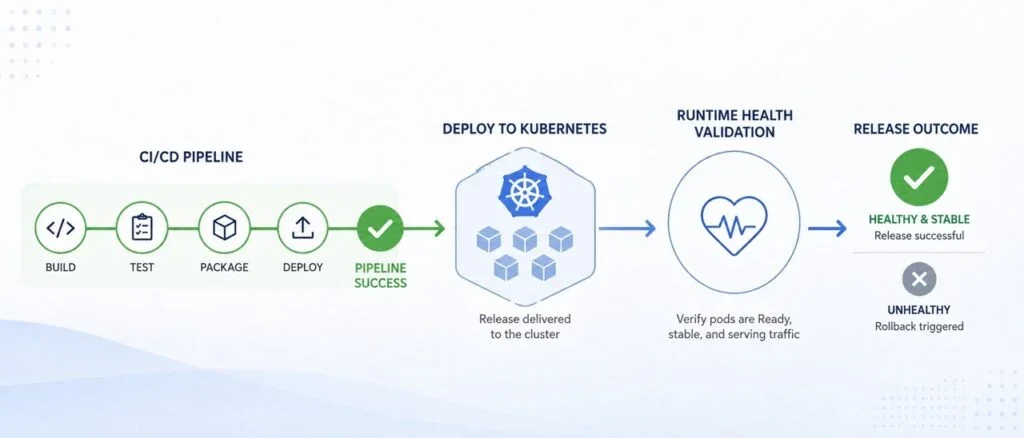
Enhancing Kubernetes Release Confidence with Automated Post-Deployment Validation
Streamlining Kubernetes release validation transformed our process, reducing check times from 45 minutes to just 2, boosting reliability and operational confidence.
Artificial intelligence and machine learning news
Found 481 articles
Streamlining Kubernetes release validation transformed our process, reducing check times from 45 minutes to just 2, boosting reliability and operational confidence.
Docker’s new Virtual Machine Manager aims to streamline performance across Windows, macOS, and Linux, reducing cross-platform issues for users.
Discover how to address Kubernetes' limitations in GPU resource allocation to reduce costs and improve efficiency for AI and machine learning applications.
Cloud-native architectures enhance speed but complicate testing, as independent deployments often lead to outdated mocks and unreliable integration tests.
Unlock the full potential of GPU resources in Kubernetes by transitioning from rigid pod assignments to more flexible, optimized configurations.
Implement automatic reviews to ensure your AI agent skills are secure before deployment, mitigating the risks of malicious code and security breaches.
Integrating AI into incident response necessitates significant workflow changes, transforming traditional tools into efficient AIOps systems.
As AI agents gain new operational capabilities, the need for kernel-level monitoring becomes essential to mitigate emerging security risks.
A recent winter storm exposed the vulnerabilities in a large LLM pipeline, prompting a redesign to ensure stability during traffic spikes.
This article outlines the development of an automated incident triage agent using .NET to streamline alerts and improve response efficiency.
Structured logging is essential for effective observability in distributed systems, yet many teams struggle to implement it efficiently.
Streamline your microfrontend projects with an efficient approach to integrating React components, minimizing redundant code.
By 2026, autonomous AI agents will significantly enhance software development workflows, automating tasks and changing team dynamics.
Efficiently identifying sensitive data before masking is essential in Test Data Management to prevent privacy breaches during application development.
Learn how optimizing the PyFlink pipeline cut p99 latency from 3-5 seconds to approximately 500 milliseconds by addressing processing bottlenecks.
DraftKings reported a revenue decline despite increased betting activity, as the company emphasizes expansion in its Predictions market strategy.
AI is reshaping software development, introducing new challenges in code governance as volume and complexity increase.
Google's GKE Agent Sandbox offers a secure environment for executing untrusted code, revolutionizing how we manage application security in AI platforms.
An unexpected traffic surge exposed the limitations of container orchestration, highlighting a mismatch between web service assumptions and AI model load times.
Branch networks demand new security strategies, moving beyond traditional models to embrace policy-driven approaches for enhanced protection.