Apple’s Foldable iPhone Projected to Boost Smartphone Panel Shipments Significantly
According to insights from Counterpoint Research, Apple’s upcoming foldable smartphone is poised to invigorate the foldable panel market, predicting a substantial rise in shipments throughout the year.
Significant Growth in Foldable Smartphone Shipments
Counterpoint Research reveals a projected 24% growth in foldable smartphone panel shipments for 2026, accompanied by an anticipated revenue increase of about 48% year-on-year. This rebound is particularly notable as shipments had previously declined by 7% in Q1 2026 compared to the same quarter in 2025. The drop was largely attributed to brand inventory management and a lull in new product launches. Such fluctuations illustrate the volatile nature of the smartphone market, where supply chain challenges and consumer demand can heavily influence shipment figures.
This uptick in foldable shipments is not just a number; it indicates an evolving consumer appetite for more flexible device designs. As smartphones become more integrated into daily life, the quest for multifunctional devices has led to greater interest in foldables, which offer larger screens while maintaining portability. This trend suggests that while consumers are often hesitant to invest in new form factors, the right combination of features and brand reputation can drive significant changes in buying behavior.
During this period, BOE retained its status as the leading supplier with a commanding 45% market share, followed by Samsung Display at 22%. Visionox, TCL CSOT, and Tianma accounted for 16%, 13%, and 4%, respectively, with the latter seeing a staggering 578% growth year-on-year, a noteworthy statistic in this dynamic market. That dramatic increase for Tianma illustrates how smaller players can capitalize on trends—even when market leaders dominate, opportunities for growth still exist for nimble companies adapting to new consumer needs.
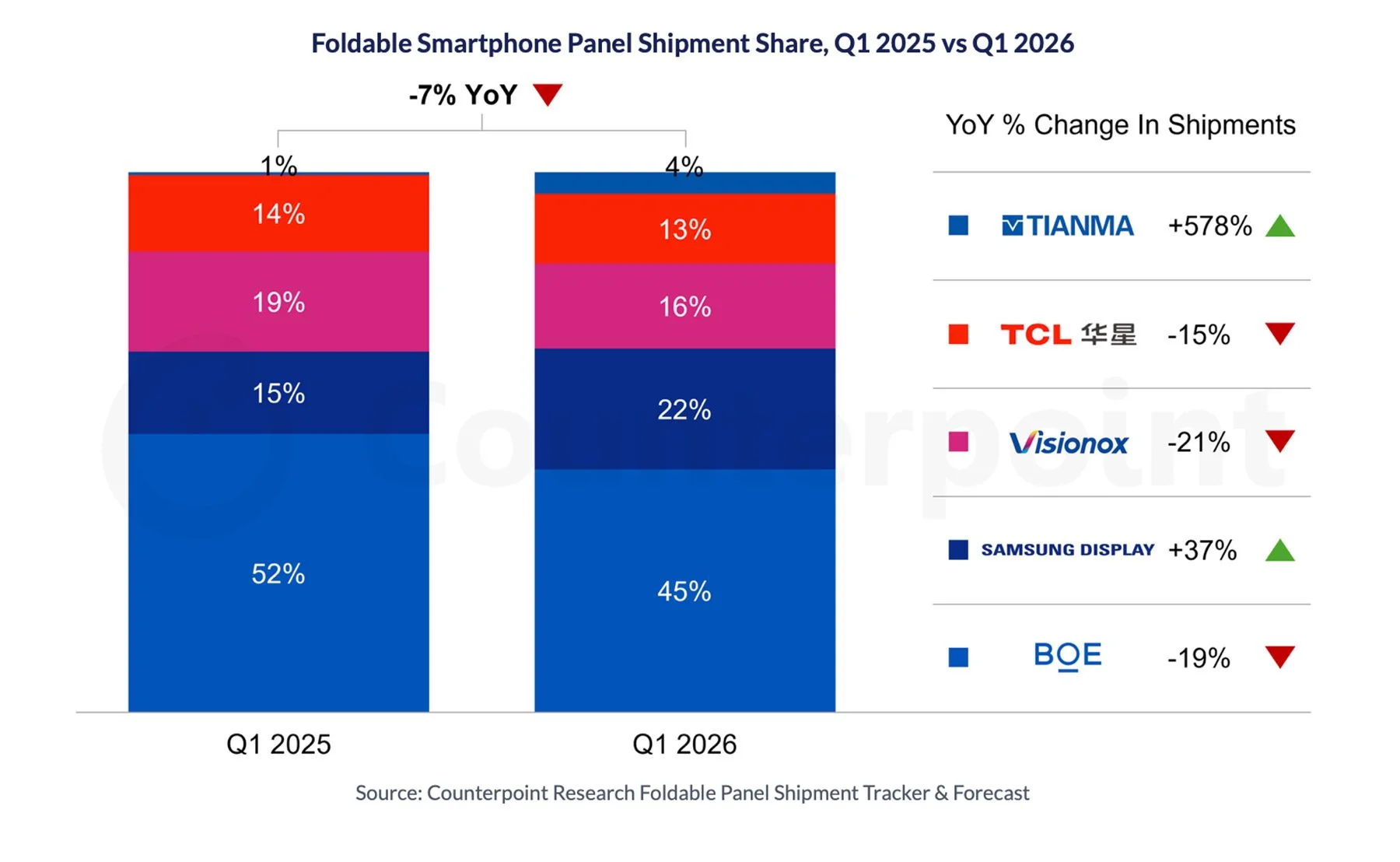
Reports indicate that Samsung Display is set to be the exclusive supplier of panels for Apple’s debut foldable iPhone. This strategic collaboration is likely to further enhance Samsung’s growth trajectory. Evidence from the first quarter of 2026 shows a 37% year-on-year increase in shipments, allowing them to capture an additional seven percentage points of market share. This move could also fortify Samsung’s position against competitors, as Apple’s reputation tends to elevate the profile of its suppliers, making them indispensable within the broader tech ecosystem.
The Shift Toward In-Fold Devices
Enze Qi, Senior Analyst at Counterpoint, emphasized the transformation of in-fold devices from a niche category to a mainstay in the market. "In-fold has moved from a secondary form factor to the mainstream," Qi observes, highlighting how the demand is not solely driven by Apple’s entry but also by an increasing need for productivity and larger displays. With users demanding devices that can perform multiple functions—from entertainment to work—foldables may offer a unique solution that traditional slabs cannot compete with.
As the market adapts, brands are starting to push the boundaries of what handsets can offer. Trends reflect that consumers want devices that enhance their productivity while also catering to their desire for portability. If Apple’s foldable successfully marries these two demands, it could alter the way users engage with smartphones. The rapid pace of technological advancement driven by player competition means consumers always expect more. This expectation sets the stage for potentially significant innovations in foldable technology in the near future.
While Apple's upcoming foldable will play a significant role, the dynamics in the market suggest a broader trend. Counterpoint anticipates 2026 to experience a bifurcated year, where the first half tests the lower limits, and the latter half witnesses a recovery. "If Apple and Samsung effectively roll out new models that enhance user experience, foldables are likely to re-enter a growth cycle," Qi concludes. The duality in projections indicates that consumer confidence could return as innovations prove appealing, but it’s a risky bet. The uncertainty surrounding market recovery often hinges on successful product launches and public reception.
This is more significant than it looks: the success of Apple’s entry into this market isn't just about folding displays. It’s about how the company can sustain interest and demand over time. Brands that once faltered with foldable products may very well be waiting for Apple’s confirmation that the concept is viable. If you're working in this space, keeping an eye on how Apple manages this transition could provide key insights into consumer behavior and technology uptake moving forward.
Future Outlook: Implications for the Smartphone Market
The implications of Apple entering the foldable smartphone market are profound. Expect to see competitive pressure increase across the board, as other manufacturers feel the burn to innovate or risk being left behind. The foldable market could no longer be seen as an experimental side project but rather as a crucial element of smartphone offerings for all key players. Consumers may soon feel they have options that genuinely enhance their digital lives—not just gimmicks.
The potential for growth in this segment may also spur further investment in research and development, as manufacturers attempt to iron out durability issues and enhance user interfaces tailored for foldables. That said, the majority of foldable launches have faced a myriad of complications, and consumers are just beginning to explore the practical applications of this technology.
The results of Apple's entry into the foldable space will be closely watched, not only by tech enthusiasts but by analysts predicting the direction of the industry as a whole. More than simply expanding its product line, Apple may very well redefine how we think about smartphones in the next iteration of mobile technology.
For a deeper dive into Counterpoint Research’s findings, follow this link.