Exploring Powerful Open Source Omni AI Models for Multimodal Interaction
Introduction
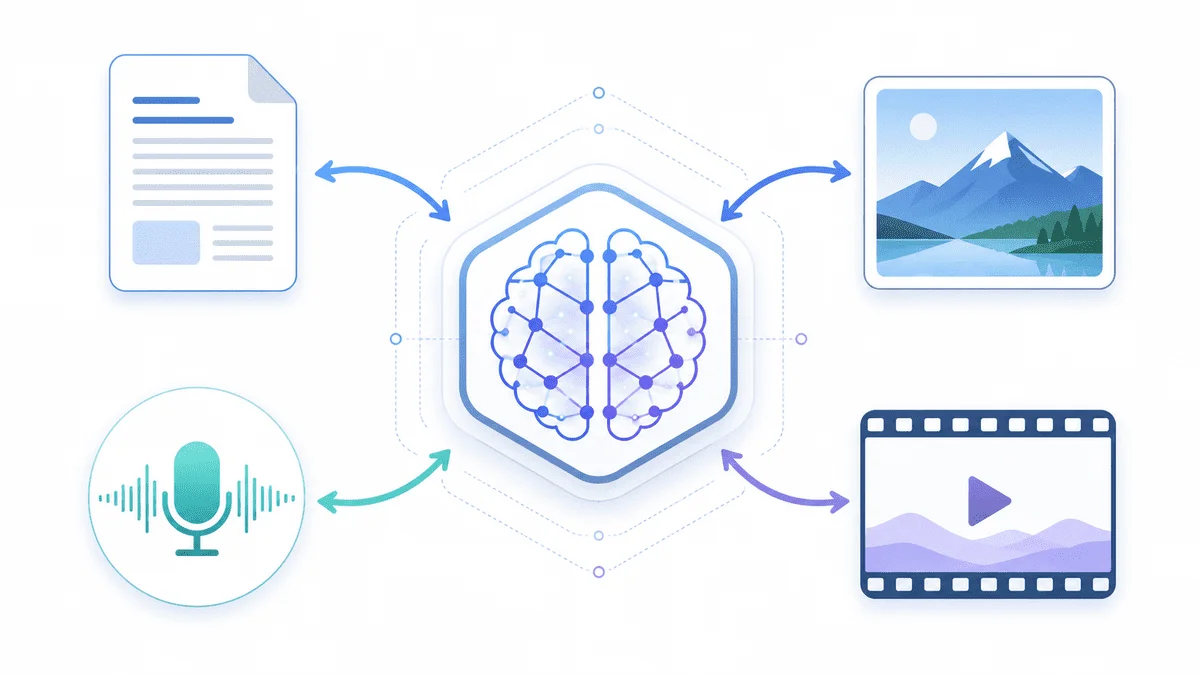
Omni AI models are making significant strides, moving from theoretical possibilities to practical applications in today’s tech landscape. Historically, multimodal systems relied on separate models for text, images, audio, and video, complicating development and decreasing efficiency. Now, however, open-source omni AI models are emerging, capable of unified processing across these various modalities, enabling real-time interaction and analysis.
This article examines five notable open-source omni AI models that are advancing the field, illustrating the capabilities and differences among them. While not all are full "any-to-any" systems, understanding their strengths can guide developers in selecting the right technology for specific applications.
NVIDIA Nemotron 3 Nano Omni 30B A3B Reasoning
The NVIDIA Nemotron 3 Nano Omni 30B A3B Reasoning stands out for its robust support of enterprise-level multimodal functions. Capable of processing video, audio, images, and text, it generates high-quality text responses, making it invaluable for complex tasks like video analysis, audio transcription, and graphical interface understanding.
Built on a 31 billion parameter Mamba2-Transformer hybrid architecture, it leverages approximately 3 billion active parameters per token. This design allows it to handle extensive content, supporting a remarkable 256K-token context, ideal for analyzing lengthy documents such as transcripts or training materials. Its practical applications extend to customer support systems and media analysis, making it a versatile tool for businesses.
Best for: enterprise-level video and speech analysis, document intelligence, and user interaction workflows.
Google Gemma 4 12B IT
Part of the Google DeepMind's Gemma model family, the Google Gemma 4 12B IT is notable for its compact and efficient design tailored for local hosting. This model can handle diverse inputs—text, images, audio, and video—while producing text responses, making it suitable for a variety of tasks including visual question answering and audio transcription.
What’s particularly intriguing about the Gemma 4 model is its encoder-free architecture, which projects raw data directly into the language model, bypassing traditional encoding processes. This innovation enables handling of longer documents and large datasets seamlessly. Additionally, it supports a 256K-token context length, facilitating engagement with extensive inputs.
Best for: multimodal assistant applications and efficient document comprehension.
Qwen3-Omni 30B A3B Instruct
The Qwen3-Omni 30B A3B Instruct integrates an end-to-end multilingual framework, effectively managing text, images, and audio to produce immediate responses in both text and speech. Its capacity for real-time analysis makes it ideal for use cases such as speech recognition and visual and audio dialogue.
Utilizing a Mixture-of-Experts architecture, this model distinguishes between multimodal reasoning and speech output, optimizing both performance types. Its real-time interaction capabilities along with a comprehensive multilingual support system for both input and output significantly enhance its global applicability.
Best for: interactive AI assistants and real-time language translations during videoconferences.
DeepSeek Janus-Pro 7B
The DeepSeek Janus-Pro 7B emphasizes the intersection of visual understanding and image generation. While not a full omni model, its capability to perform tasks like image reasoning and text-to-image generation within one framework is compelling. Using a dual-pathway autoregressive setup, it effectively decouples the understanding and generation processes for images.
Janus-Pro leverages a dedicated vision encoder and features text prompt-driven image generation, a key advantage in creative applications. This approach minimizes interference between visual analysis and image synthesis, boosting overall efficiency.
Best for: visual arts and content generation workflows that require integration of visual comprehension and creativity.
MiniCPM-o 4.5
The MiniCPM-o 4.5 is pioneering in its full-duplex multimodal streaming capabilities, enabling simultaneous text, image, audio, and video processing. Its 9 billion parameter architecture supports advanced real-time interactions, effectively powering AI assistants that can engage in conversations while analyzing visual data.
This model excels in continuous interaction, capable of proactive responses and dynamic engagement with user scenarios such as live presentations or interactive learning environments. Its deployment on various platforms adds further flexibility, making it an attractive option for developers specializing in edge AI applications.
Best for: live AI applications requiring real-time communication with users.
Final Thoughts
The evolution of omni AI models is crucial as they transition from isolated functions to integrated systems that understand diverse forms of input interactively. The traditional model of stacking separate systems is yielding to a more cohesive architecture that reduces complexity and enhances performance. As these models continue to evolve, they promise a future where seamless, real-time interactions across multiple modalities become the norm.